Showing posts with label first aid. Show all posts

Saturday, February 11, 2012

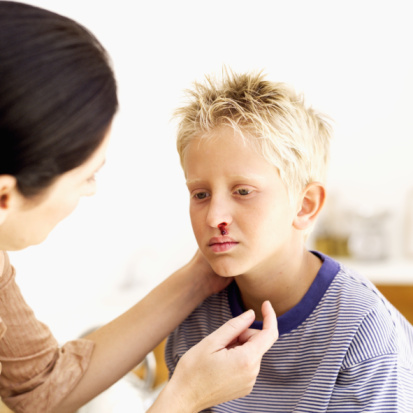
Nosebleed (Epistaxis): First Aid


Where does the blood in a nosebleed come from?
The blood usually comes from a blood vessel located in the front of the nasal septum (nasal partition) or further back in the nasal cavity.


What can cause a nosebleed?
·         Picking the nose.
·         A blow to the nose or damage to the mucous membrane.
·         cold or flu.
·         nasal allergy.
·         Dry mucous membranes in the nose due to a stuffy indoor atmosphere.
·         Hypertension (high blood pressure) - rarely.
·     Certain kinds of medication; for instance, products that reduce the viscosity of the blood (such as aspirin (eg Micropyrin)and non-steroidal anti-inflammatory drugs).
·         Exposure to chemicals that may irritate the mucous membranes.
·         Deviation of the nasal (septum).
Most nosebleeds occur for no obvious reason.

Other rare causes of nosebleeds
·         Blood diseases such as leukaemia or haemophilia.
·         Tumours in the nasal cavity.
·         Osler's disease.

Danger signals in a severe nosebleed
·         Heavy bleeding.
·         Palpitation, shortness of breath and turning pale.
·         Swallowing large amounts of blood, which will cause you to vomit.

How to avoid nosebleeds
·         Avoid damaging the nose and excessive nose-picking.
·         Seek medical treatment for any disease causing the nosebleeds.
·         Get a humidifier if you live in a dry climate or at high altitude.

What to do if you get a nosebleed
·         Sit in an upright position with your head bent forward.
·         Hold the tip of your nose for five minutes while breathing through the mouth.
·         If the bleeding stops and then returns, hold your nose for 8 to 10 minutes. This will allow time for the blood to clot.
·         Applying an ice-pack to your nose may help.

Good advice
·         Do not blow your nose for the next 12 hours after the bleeding has stopped. This will help the dried blood to remain in place.
·         Do not swallow the blood. It can cause you to become nauseous and vomit, or could conceal a greater blood loss.
·         If you frequently suffer from nosebleeds you should seek help from your doctor.

The most likely development
·         The bleeding usually stops if you follow the above instructions.
·         Heavy bleeding may require hospital treatment and, in rare cases, a blood transfusion.

How is heavy bleeding treated and what kind of medication can be given?
Contact your doctor if the advice described above does not help stop the bleeding.
Initially, the doctor will try to stop the bleeding by using something that will make the blood vessels contract.
When the bleeding has stopped, the doctor may choose to cauterise the source of the bleeding with a chemical to prevent it bleeding again.

If the bleeding fails to stop, it may be necessary to put a pack in the nose.
In rare cases, an operation may be necessary to tie off the blood vessel that supplies the bleeding area.
If the bleeding is caused by another disease, such as increased blood pressure, it is very important to seek treatment to avoid recurrence of nosebleeds.

Nosebleeds can be very intermittent, and between bleeds it may be very difficult to determine their source. If this occurs it is best to ensure that the nose is inspected during a bleed, which might mean needing to be assessed 'out of hours' by the on-call GP or local casualty unit.

Burns: First Aid


To distinguish a minor burn from a serious burn, the first step is to determine the extent of damage to body tissues. The three burn classifications of first-degree burn, second-degree burn and third-degree burn will help you determine emergency care.
1st-degree burn

The least serious burns are those in which only the outer layer of skin is burned, but not all the way through.

  • The skin is usually red
  • Often there is swelling
  • Pain sometimes is present
Treat a first-degree burn as a minor burn unless it involves substantial portions of the hands, feet, face, groin or buttocks, or a major joint, which requires emergency medical attention.
2nd-degree burn
When the first layer of skin has been burned through and the second layer of skin (dermis) also is burned, the injury is called a second-degree burn.

  • Blisters develop
  • Skin takes on an intensely reddened, splotchy appearance
  • There is severe pain and swelling.
If the second-degree burn is no larger than 3 inches (7.6 centimeters) in diameter, treat it as a minor burn. If the burned area is larger or if the burn is on the hands, feet, face, groin or buttocks, or over a major joint, treat it as a major burn and get medical help immediately.
For minor burns, including first-degree burns and second-degree burns limited to an area no larger than 3 inches (7.6 centimeters) in diameter, take the following action:
  • Cool the burn. Hold the burned area under cool (not cold) running water for 10 or 15 minutes or until the pain subsides. If this is impractical, immerse the burn in cool water or cool it with cold compresses. Cooling the burn reduces swelling by conducting heat away from the skin. Don't put ice on the burn.
  • Cover the burn with a sterile gauze bandage. Don't use fluffy cotton, or other material that may get lint in the wound. Wrap the gauze loosely to avoid putting pressure on burned skin. Bandaging keeps air off the burn, reduces pain and protects blistered skin.
  • Take an over-the-counter pain reliever. These include aspirin, ibuprofen (Advil, Motrin, others), naproxen (Aleve) or acetaminophen (Tylenol, others). Use caution when giving aspirin to children or teenagers. Though aspirin is approved for use in children older than age 2, children and teenagers recovering from chickenpox or flu-like symptoms should never take aspirin. Talk to your doctor if you have concerns.
Minor burns usually heal without further treatment. They may heal with pigment changes, meaning the healed area may be a different color from the surrounding skin. Watch for signs of infection, such as increased pain, redness, fever, swelling or oozing. If infection develops, seek medical help. Avoid re-injuring or tanning if the burns are less than a year old — doing so may cause more extensive pigmentation changes. Use sunscreen on the area for at least a year.
Caution
  • Don't use ice. Putting ice directly on a burn can cause a person's body to become too cold and cause further damage to the wound.
  • Don't apply egg whites, butter or ointments to the burn. This could cause infection.
  • Don't break blisters. Broken blisters are more vulnerable to infection.
3rd-degree burn

The most serious burns involve all layers of the skin and cause permanent tissue damage. Fat, muscle and even bone may be affected. Areas may be charred black or appear dry and white. Difficulty inhaling and exhaling, carbon monoxide poisoning, or other toxic effects may occur if smoke inhalation accompanies the burn.

For major burns, call 911 or emergency medical help. Until an emergency unit arrives, follow these steps:
  1. Don't remove burned clothing. However, do make sure the victim is no longer in contact with smoldering materials or exposed to smoke or heat.
  2. Don't immerse large severe burns in cold water. Doing so could cause a drop in body temperature (hypothermia) and deterioration of blood pressure and circulation (shock).
  3. Check for signs of circulation (breathing, coughing or movement). If there is no breathing or other sign of circulation, begin CPR.
  4. Elevate the burned body part or parts. Raise above heart level, when possible.
  5. Cover the area of the burn. Use a cool, moist, sterile bandage; clean, moist cloth; or moist cloth towels.
Get a tetanus shot. Burns are susceptible to tetanus. Doctors recommend you get a tetanus shot every 10 years. If your last shot was more than five years ago, your doctor may recommend a tetanus shot booster.